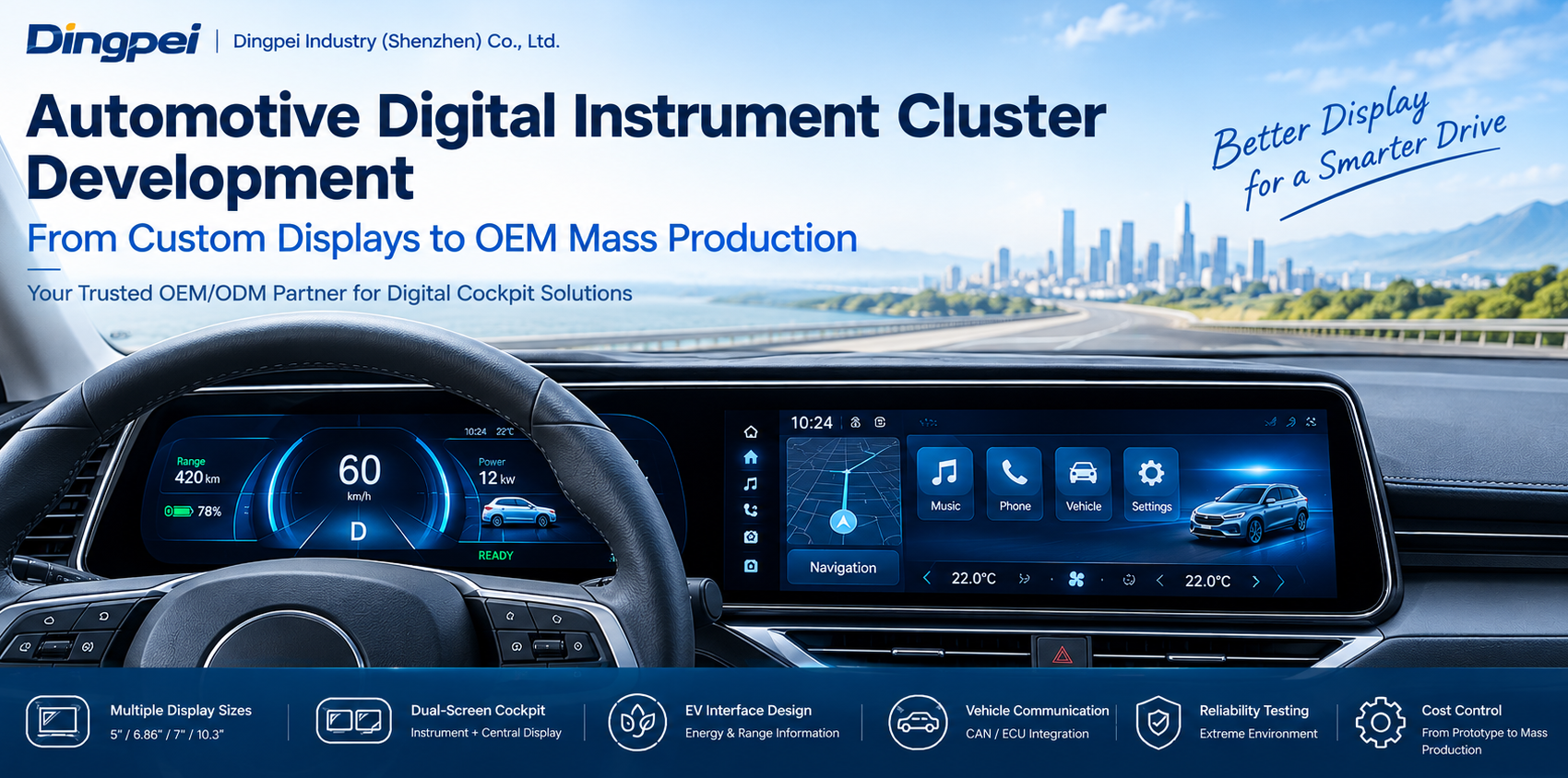
Developing a custom automotive digital instrument cluster requires more than choosing a screen. For OEM vehicle programs, the display must communicate accurately with vehicle electronics, present critical information clearly, withstand automotive environments, and fit both the dashboard and production budget. Electric vehicles and dual-screen cockpits add further requirements for interface design and system integration.
At Dinpei Industry (Shenzhen) Co., Ltd., we evaluate instrument cluster projects around the vehicle platform, rather than assuming one display configuration suits every model. This guide covers screen selection, dual-screen integration, EV interfaces, vehicle communication, validation, and the steps from prototype to mass production.
1. Choose the Display Around the Vehicle Platform
Screen size affects more than appearance. It influences dashboard packaging, mounting structures, user-interface layout, electrical integration, and total project cost. A larger display may offer richer graphics, but it can also require changes to the dashboard or associated hardware. OEM teams should first define the available space, essential driver information, target vehicle segment, and cost limits.
Common instrument cluster sizes
· 5-inch: A compact, cost-conscious choice for entry-level vehicles displaying essential driving information.
· 6.86-inch: Suitable for smaller vehicles, including compact EVs, where space is limited but a graphical interface is desired.
· 7-inch: A balanced option for passenger and commercial vehicles needing readable information without an oversized installation.
· 10.3-inch: Provides greater flexibility for customized graphics, vehicle status displays, and modern digital cockpit layouts.
Dinpei's documented instrument cluster projects cover these size categories. Final selection should be based on the vehicle's physical constraints, available signals, functional needs, and market positioning—not screen size alone.
2. Design Dual-Screen Cockpits as One System
An integrated cockpit may combine the instrument cluster and central infotainment display into a coordinated layout. Yet a dual-screen solution is more than two panels placed side by side. The displays must have complementary roles: the cluster prioritizes speed, status, and warnings, while the central screen may handle multimedia, settings, navigation, and interaction features, depending on the system.
OEM teams should align screen dimensions, viewing angles, dashboard structure, graphics, and system architecture from the start. A consistent visual language is useful, but critical driving information must remain distinct and easy to locate.
Case study: BAIC Manufacturing M7
Dinpei's documented BAIC Manufacturing M7 electric-vehicle configuration uses a 10.3-inch instrument cluster paired with a 10.3-inch central display. The integrated layout illustrates how screen placement, information hierarchy, and IPS display presentation can contribute to a coherent cockpit design. Voice or connected interaction features may be accommodated depending on the final system configuration; they should not be assumed to be standard features of every dual-screen project.
The same model range also demonstrates the value of different configurations. Its documented gasoline-powered version uses a 7-inch instrument cluster with a 10.3-inch central display. This allows vehicle variants to follow a similar cockpit concept while addressing different cost and positioning requirements.
For multi-variant vehicle programs, manufacturers should assess whether software foundations, communication interfaces, and hardware components can be shared. Actual reuse depends on mounting geometry, electrical architecture, software compatibility, and validation requirements. Planning these questions early can reduce duplicated engineering work.
3. Build EV Instrument Clusters Around Relevant Data
Electric vehicles change what drivers need from an instrument cluster. In addition to speed and warnings, an EV display may need to show battery state of charge, remaining range, power input or output, vehicle-ready status, and other electrical-system information.
The interface should make these values understandable at a glance. For example, a battery percentage can be supported by a clear graphic, while energy-flow information should not compete with primary driving indicators. More animation or visual detail does not necessarily improve usability.
Data accuracy is essential. Remaining-range estimates depend on vehicle calculations and data provided by the relevant electronic systems. The cluster should display the agreed values and warning logic rather than assume it can calculate accurate range independently. Available signals, units, and behavior under abnormal conditions must be defined with the OEM engineering team.
Case studies: Wuling Zhiguang EV and BAIC Yuanbao EV
Dinpei's documented projects for the Wuling Zhiguang EV and BAIC Manufacturing Yuanbao EV each feature a 10.3-inch instrument cluster and 10.3-inch central display. These solutions illustrate EV-focused UI customization, integrated layouts, and vehicle-specific adaptation.
The broader lesson is to establish the vehicle data list, screen hierarchy, warning behavior, and interaction requirements before software development is finalized. An EV interface should reflect the actual vehicle architecture, not simply reproduce a gasoline-vehicle dashboard with different graphics.
4. Customize the UI Without Compromising Readability
A custom digital instrument cluster helps express a vehicle brand through graphics, colors, typography, and information arrangement. However, visual identity must support safe, practical communication. A commercial vehicle may require especially prominent status information; a passenger EV may place greater emphasis on battery and energy data.
A useful OEM UI specification should address:
· Information hierarchy: Keep speed, essential status, and warning indicators immediately recognizable.
· Readability: Evaluate text size, contrast, spacing, and graphics in realistic viewing conditions.
· Vehicle-specific functions: Display only information supported by the vehicle's systems and agreed signal definitions.
· Cockpit consistency: Coordinate the cluster and central-screen visual language without obscuring their different purposes.
· Market localization: Define languages, measurement units, symbols, and regional requirements early.
These decisions should be reviewed alongside display hardware and dashboard geometry. An attractive interface mockup alone does not demonstrate that a design will work reliably in the vehicle.
5. Define Vehicle Communication Before Development
Unlike a standalone monitor, an automotive digital instrument cluster depends on information from the vehicle's electronic systems. Depending on the platform, this may involve the engine control unit, battery management system, sensors, or other control units.
For OEM projects, early communication documentation is one of the most valuable inputs. Engineering teams should agree on the protocol and physical interface; signal definitions and formats; message identifiers and update rates where applicable; startup and shutdown behavior; warnings; timeouts; diagnostics; and fault handling.
Where CAN communication is used, a CAN database or equivalent signal document helps define how each value should be interpreted. In an EV, for example, state of charge and vehicle-ready status must map to the correct vehicle signals. Missing or inconsistent data can produce incorrect displays even when the panel itself operates normally.
Communication requirements also affect hardware selection. The display panel, mainboard, processor, power management, connectors, software, and mechanical design must function as one system. Providing interface documents and dashboard drawings early helps suppliers identify feasibility issues before prototypes are built.
Practical interface review before prototyping
A useful review involves both the supplier and the vehicle engineering team. Together, they can confirm which signals are available, which values need conversion or filtering, and how the cluster should respond when data is delayed or unavailable. The review should also clarify whether any warning indicators require special behavior during startup, shutdown, or communication loss. These details can appear minor in a design presentation, but they are central to predictable operation once the display is connected to the vehicle.
For international OEM programs, agreeing on a version-controlled interface specification is especially helpful. It gives the hardware, software, and vehicle teams a shared reference when requirements change during development.
6. Validate Reliability for Automotive Conditions
Vehicle electronics face temperature changes, vibration, electrical disturbances, and extended operating periods. Consumer-display performance in a laboratory is not sufficient evidence of automotive suitability. Validation must follow the intended vehicle environment and agreed OEM specifications.
Temperature: Define the operating range for each project. One documented Dinpei 10.3-inch cluster solution specifies −40°C to +85°C, but this is a project-specific rating, not a universal specification for all Dinpei products. Testing should verify acceptable operation across the required conditions.
Vibration and mechanical fit: Assess the enclosure, mounting points, connectors, and internal assemblies. Retrofit or replacement designs also need careful checks of dashboard clearances and connector placement.
Electromagnetic compatibility: Power design, PCB layout, grounding, shielding, and interface protection can influence how the cluster performs alongside other vehicle electronics. Applicable test requirements should be confirmed with the OEM.
System validation: Depending on the project, testing may cover environmental performance, electrical behavior, communication accuracy, and electromagnetic compatibility. Problems found during validation should be resolved before production approval.
Reliability is an outcome of coordinated design, integration, testing, and manufacturing—not simply a feature of the display panel.
7. Control Cost Across the Product Lifecycle
The cheapest display component does not always create the lowest-cost OEM project. Additional tooling, software changes, integration work, or production issues can outweigh initial savings. A better approach is to select the minimum configuration that fully meets the vehicle's functional and quality requirements.
Compact screens may be appropriate for entry-level vehicles, while larger panels can be justified by more advanced cockpit requirements. For vehicle families with several trim levels, engineering teams should explore shared software, standardized interfaces, and common components where feasible, without assuming different screen sizes are automatically interchangeable.
Production volume, tooling investment, component availability, maintenance, spare parts, and future model updates should also inform the decision. Clear specifications reduce late changes and make cost discussions more meaningful for both manufacturer and supplier.
Questions to resolve before requesting a quotation
Before comparing supplier prices, OEM buyers should determine whether they need a complete custom instrument cluster, a modification of an existing design, or an integrated cluster-and-center-screen solution. They should also distinguish essential functions from optional visual enhancements. Without this separation, quotations may cover different technical scopes and become difficult to compare.
Another consideration is the planned production lifecycle. An initial pilot order and a long-running vehicle program may need different approaches to tooling, component sourcing, spare units, and software updates. Discussing these factors at the beginning supports more realistic cost and delivery expectations.
8. Move from Prototype to OEM Mass Production
A working prototype demonstrates a concept; a production-ready cluster must meet agreed specifications consistently. Dinpei recommends a structured development discussion that covers the following stages:
1. Requirement collection: Confirm vehicle model, target display, functions, dashboard constraints, interface documentation, volume, and schedule.
2. Feasibility review: Evaluate hardware, software, UI, communication, mechanical integration, and technical risks.
3. Design and development: Develop or adapt the agreed display, electronics, software, interface, and housing.
4. Prototype evaluation: Check display quality, installation, communication, and functional behavior; document requested changes.
5. Testing and validation: Verify the prototype against agreed technical, electrical, and environmental requirements.
6. Production preparation: Approve final specifications, samples, inspection criteria, manufacturing processes, packaging, and delivery plans.
7. Mass production and support: Manufacture to the approved requirements and coordinate subsequent changes throughout the product lifecycle.
The exact sequence varies with project complexity and the OEM's own development process. A modified existing platform may need a different schedule from a project involving substantial new hardware or software.
9. Selecting an OEM Instrument Cluster Partner
A supplier should be evaluated on more than panel price. OEM customers benefit from a partner that understands complete vehicle integration and can communicate technical limits clearly.
Key questions include whether the supplier has relevant automotive project experience, supports customized displays and UI design, can review vehicle communication specifications, and can define suitable validation activities. Production capability, documentation quality, change management, and responsiveness also matter, especially for overseas projects.
It is important to distinguish proven existing functions from capabilities requiring additional development. Early technical review helps both parties agree on realistic specifications, schedules, and responsibilities.
Why work with Dinpei Industry?
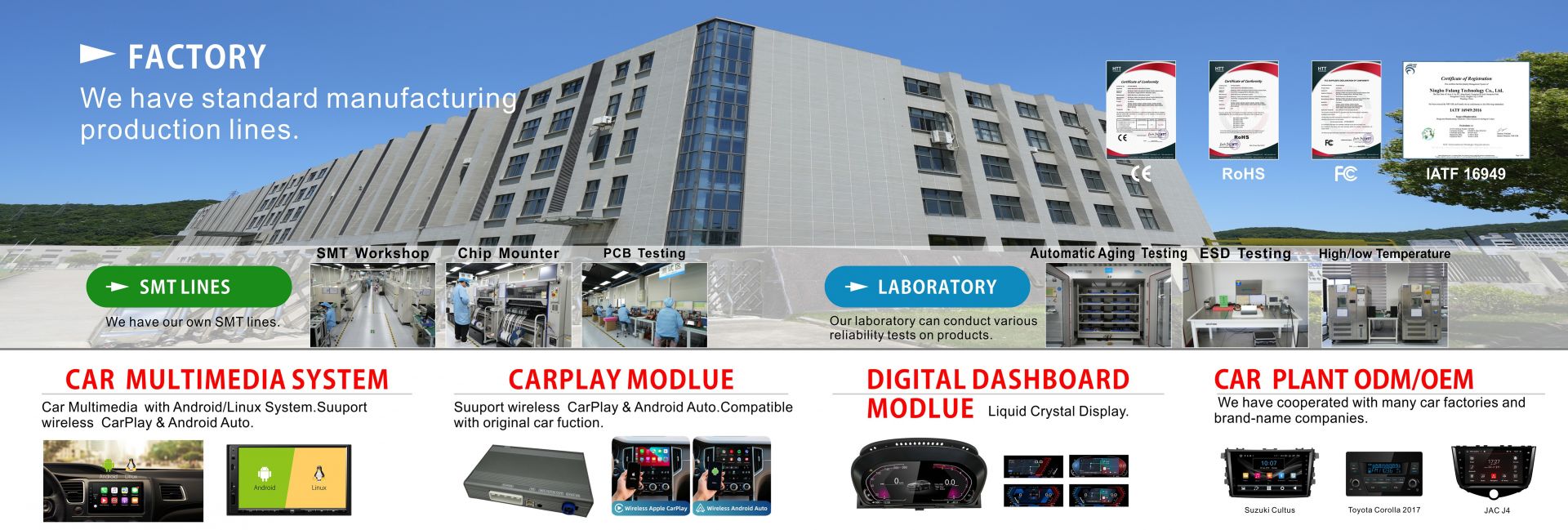
Dinpei Industry (Shenzhen) Co., Ltd. works on OEM/ODM automotive electronics, including vehicle multimedia and in-vehicle display solutions. Its documented instrument cluster portfolio spans compact 5-inch displays through 10.3-inch clusters and integrated dual-screen configurations.
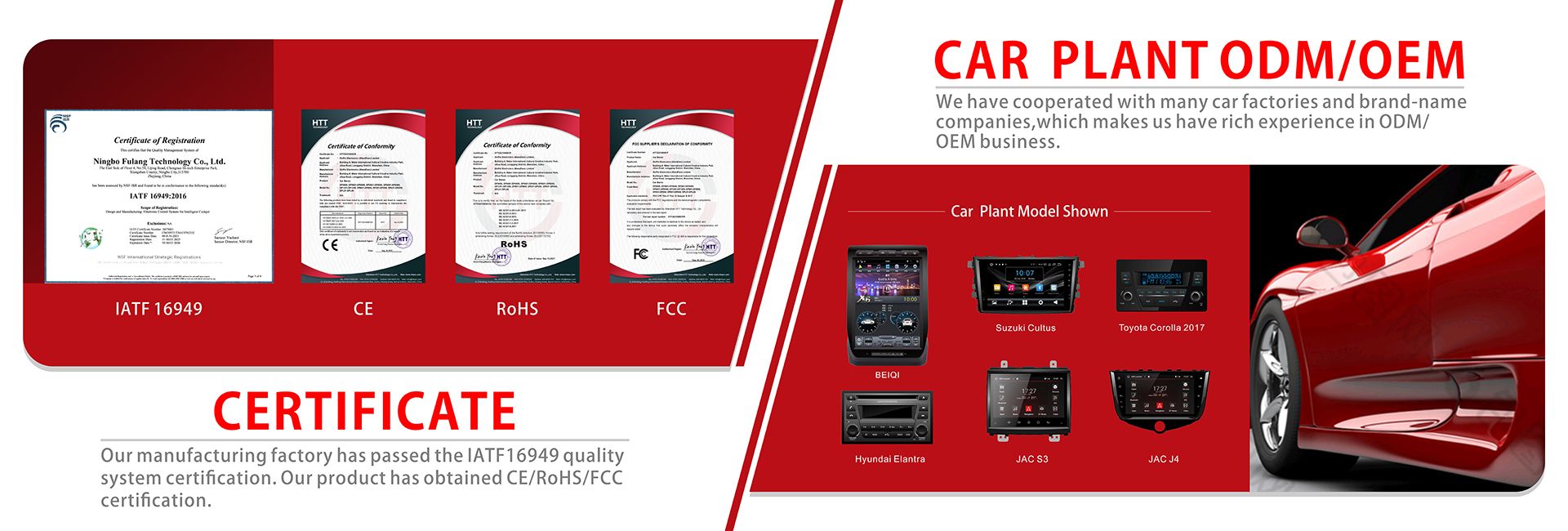
Referenced vehicle programs include the BAIC Manufacturing M7, Wuling Zhiguang EV, BAIC Manufacturing Yuanbao EV, Changan Eado DT, and Huaihai ET. These projects reflect different priorities, from compact and cost-conscious displays to customized EV interfaces and coordinated cockpit layouts.
Dinpei evaluates each inquiry against the customer's dashboard structure, communication requirements, software functions, target cost, and expected production volume. Feasibility and final capabilities must be confirmed for the specific vehicle project.
Preparing for the first technical discussion
An initial OEM inquiry is more productive when it includes basic project materials. Even if the full engineering specification is not ready, a dashboard drawing, target display size, vehicle type, and list of required functions can help establish the likely development direction. Communication documentation and an estimated annual production volume allow a more detailed assessment of integration and commercial feasibility.
Where several trims or vehicle models are involved, it is useful to identify the expected differences from the outset. The supplier can then review whether any shared development work is practical rather than treating every configuration as an entirely separate project.
Conclusion: The Right Cluster Is the One That Fits the Vehicle
Successful automotive digital instrument cluster development balances display selection, driver information, vehicle communication, environmental reliability, installation, and cost. EV and dual-screen projects require particular attention to signal definitions and coordinated interface design.
For automakers, integrators, and vehicle manufacturers planning a new instrument cluster, the best starting point is a clear technical specification. Contact Dinpei Industry (Shenzhen) Co., Ltd. to discuss your OEM/ODM instrument cluster requirements, customization options, and mass-production plans.
Frequently Asked Questions
What is an OEM automotive digital instrument cluster?
It is an electronic dashboard display developed for a vehicle manufacturer's platform. It presents driving information, status, and warnings, with additional data such as EV battery information when supported by the vehicle.
Can an instrument cluster be customized for an EV?
Yes. Battery state of charge, range, power information, and vehicle-ready status can be included when the vehicle provides the necessary data and the functions are defined in the project specification.
Can the cluster and infotainment display form one dual-screen solution?
Yes. OEM development can coordinate both displays visually and mechanically while addressing each screen's software, hardware, and communication requirements.
What does an OEM need to provide to start development?
Useful inputs include the vehicle model, dashboard drawings, mounting details, display size, required functions, communication specifications, target volume, and timeline.
How long does development take?
Timing depends on customization scope, vehicle integration, prototype revisions, and validation. A meaningful estimate follows a technical feasibility review.
What must be approved before mass production?
The final specification, samples, installation compatibility, communication behavior, validation results, inspection requirements, and delivery arrangements should all be confirmed.


 English
 Russian