The design of car multimedia systems is changing very quickly. A few years ago, a 7-inch or 9-inch central display was already considered a good configuration for many vehicles. Then large 10.25-inch and 12.3-inch displays became more common. Today, many automakers and automotive electronics brands are looking at something much larger: a full-length dashboard display that can cover most of the front area of the vehicle.
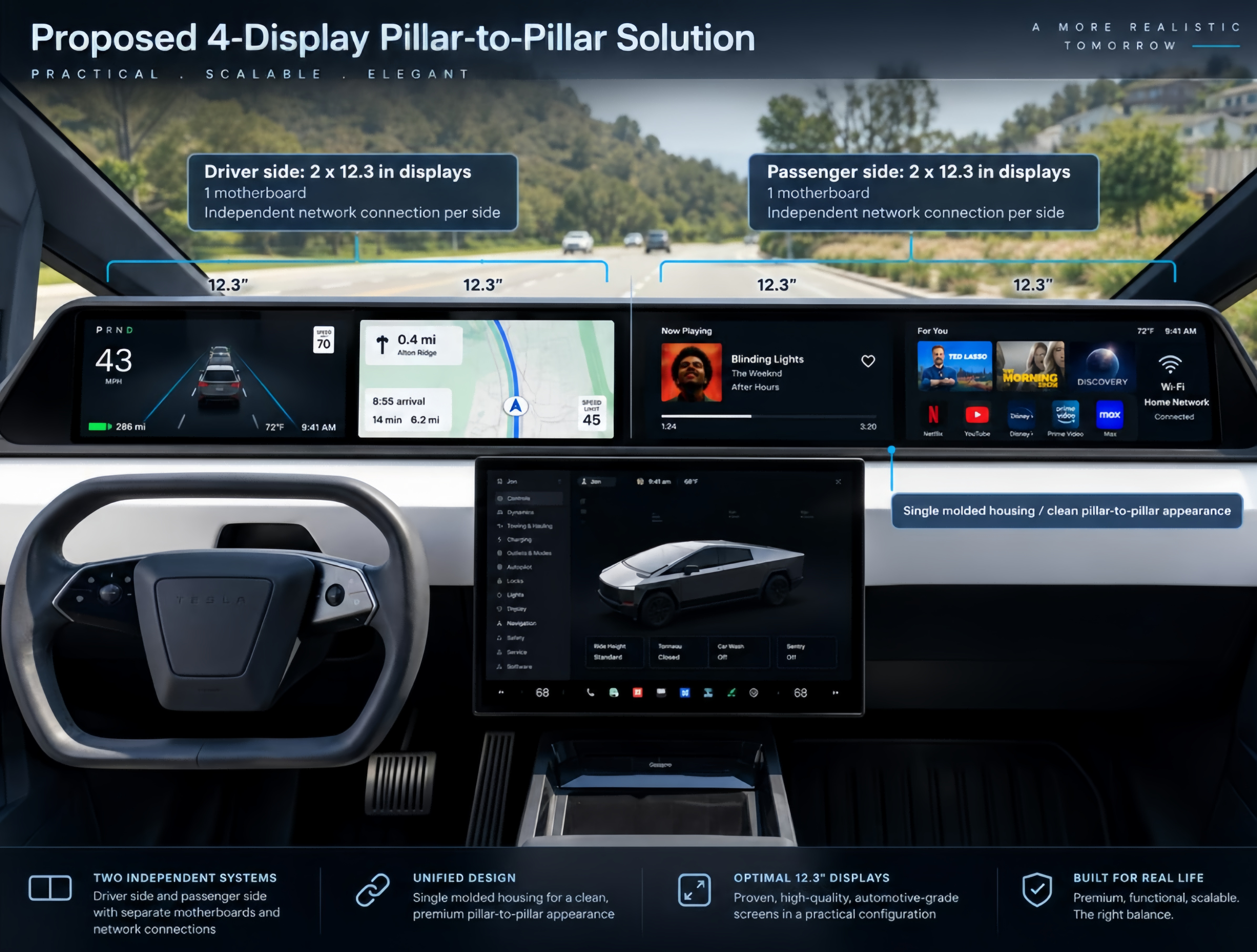
One of the most interesting directions is the four-screen car multimedia system, using four independent 12.3-inch displays to create a long, continuous visual experience across the dashboard.
At first glance, this type of system may look like simply connecting four screens together. In reality, it is much more complicated.
The display area is very long, the touch panel needs to look continuous, the system needs to provide a smooth user experience, and the hardware has to remain stable even when the vehicle interior becomes very hot.
Based on our experience in automotive multimedia OEM and ODM development, one practical way to develop this type of system is to start with an existing dual-screen architecture and extend it into a four-screen system.
This article explains how this works and some of the key technical points that need to be considered during development.
From Dual-Screen to Four-Screen
Dual-screen car multimedia systems have already become relatively mature.
A typical dual-screen system uses two 12.3-inch displays installed side by side. One screen may be used by the driver for navigation and vehicle information, while the other screen can provide entertainment, passenger controls, or additional vehicle functions.
The two displays can work together as one large visual area, while the hardware architecture is still based on a manageable dual-screen system.
This makes dual-screen technology a good starting point for developing a larger four-screen cockpit display.
For a four-screen system, the basic idea is to place four independent 12.3-inch displays side by side.
The total visual area can therefore become extremely wide.
However, the important point is that the four displays are not simply connected to one mainboard.
At the current stage of chipset technology, it is difficult to use one standard automotive multimedia mainboard to drive four 12.3-inch high-resolution displays simultaneously while still maintaining good system performance, graphics performance, thermal stability and reasonable development cost.
Because of this limitation, we recommend dividing the four-screen system into two independent dual-screen systems.
In simple terms:
12.3-inch + 12.3-inch = Dual-Screen System A
12.3-inch + 12.3-inch = Dual-Screen System B
Then these two dual-screen systems are installed together to create the complete four-screen dashboard.
This architecture is much more practical for current automotive electronics development.
One Four-Screen Device, Two Independent Mainboards
The most important hardware difference between a conventional dual-screen system and a four-screen system is the number of mainboards.
For a standard dual-screen system, one mainboard controls two 12.3-inch displays.
For the four-screen system, we use two independent mainboards.
One mainboard controls the two screens on the driver's side, while the second mainboard controls the two screens on the passenger side.
For example:
Mainboard A
• Driver-side 12.3-inch display
• Center-left 12.3-inch display
• Driver-side touch operation
• Navigation
• Multimedia
• Vehicle information
• System control
Mainboard B
• Center-right 12.3-inch display
• Passenger-side 12.3-inch display
• Passenger touch operation
• Entertainment
• Multimedia
• Passenger functions
• System control
From a hardware development point of view, this makes the project much easier to control.
Instead of developing a completely new platform capable of driving four displays from one motherboard, we can build on a mature dual-screen platform and duplicate the architecture.
This also provides another important advantage.
If one side of the system needs to be customized for a specific vehicle model, the corresponding hardware and software can be modified without redesigning the entire four-screen platform.
For OEM projects, this can significantly reduce development time and engineering risk.
Why Four 12.3-Inch Screens?
For this type of dashboard, 12.3 inches is a very practical size.
A 12.3-inch display provides enough area for navigation, vehicle information and multimedia applications, while still fitting many passenger vehicle dashboard layouts.
Using four displays also provides much more flexibility than using one extremely large panel.
For example, the four screens can be configured as:
• Driver information display
• Center navigation display
• Passenger entertainment display
• Passenger information or control display
The exact functions can be changed according to the vehicle manufacturer's requirements.
For a luxury vehicle, the passenger-side screen could be used for video and entertainment.
For a commercial vehicle, the screens could instead focus on navigation, fleet information, vehicle monitoring and driver assistance.
For an electric vehicle, additional areas can be used for energy information, battery status and charging information.
The hardware platform can remain similar while the software and user interface are customized for different vehicle applications.
The Most Important Part: Making Four Screens Look Like One
There is another major challenge.
If we simply install four independent 12.3-inch screens next to each other, the result can look like four separate monitors.
That is not the experience we want to create.
The goal of a full-length four-screen dashboard is to make the front of the system look like one large continuous display.
This is why the touch panel design is particularly important.
Instead of having four completely independent touch surfaces with obvious physical gaps, we can design the front touch layer as one continuous touch panel structure.
Behind this continuous touch surface are four independent LCD display modules.
So from the front, the user sees a long and continuous glass/touch surface.
Internally, however, the display system is still divided into four independent 12.3-inch display areas.
This is an important distinction.
The display hardware remains modular, while the front touch experience is designed as one integrated surface.
This approach makes the product look much more like a next-generation intelligent cockpit rather than several screens simply installed together.
Why the Touch Panel Is Designed as One Piece
A continuous touch panel provides several advantages.
First, the visual appearance is much cleaner.
There are fewer obvious boundaries between individual touch areas, which helps create the feeling of a single full-length dashboard display.
Second, the user experience is more natural.
The driver or passenger can interact with the interface without feeling that they are using four completely separate tablets.
Third, it creates more possibilities for UI design.
For example, a navigation map or vehicle information interface can be designed to visually extend across multiple display areas.
Of course, the LCD displays underneath are still physically separated because each 12.3-inch display is independently controlled.
Therefore, software and touch coordinate mapping need to be carefully designed during development.
This is one of the reasons why a four-screen project should be developed as a complete hardware and software system instead of simply purchasing four displays and connecting them together.
Interaction Between the Two Dual-Screen Systems
Although the four screens are divided into two hardware systems, the user experience does not have to feel divided.
This is where the software architecture becomes very interesting.
Within each dual-screen system, the two 12.3-inch displays can communicate and interact with each other.
The interface can support operations similar to a split-screen system.
For example, an application or interface element can be moved from one screen to the other.
The user can also slide certain content between the two screens, depending on the software design.
Imagine the driver-side two screens.
The left display shows the driver's main information, while the right display shows navigation.
The user can interact with the navigation interface and move certain information across the two screens.
This type of interaction gives the system a much stronger sense of technology.
It is not simply a large display.
It becomes a multi-screen intelligent cockpit interface.
For OEM customers, this is also an important opportunity to create a unique user interface that can be customized according to the vehicle brand.
Driver and Passenger Can Have Different Experiences
Another benefit of the four-screen architecture is that the driver and passenger can operate their own areas independently.
The driver can use the two screens on the driver's side for:
• Navigation
• Instrument information
• Vehicle information
• Phone calls
• Music
• Driving-related applications
At the same time, the passenger can use the two screens on the passenger side for:
• Video
• Entertainment
• Music
• Online applications
• Passenger controls
• Other customized functions
This creates a much clearer separation between driving and passenger entertainment.
For a family vehicle, the passenger can enjoy entertainment without constantly interrupting the driver's navigation interface.
For premium vehicles, this architecture can also provide a more personalized experience for both front-seat occupants.
Choosing the Right Chipset
The processor is another critical part of the four-screen system.
Because this is a large-screen multimedia platform, the processor needs to handle high-resolution graphics, multiple display outputs, Android applications, networking and multitasking.
A low-end chipset may be able to run a normal car radio or a single display, but it is not necessarily suitable for a large four-screen cockpit system.
For this reason, we recommend using a relatively high-performance octa-core platform.
One possible solution is the Qualcomm 4390 octa-core platform.
Another option is a high-end Unisoc 7870 octa-core platform.
The final chipset selection should depend on the vehicle project, display resolution, software requirements, memory configuration, communication requirements and target cost.
The important point is that the processor needs enough performance headroom.
A four-screen cockpit should not only work when the system is new.
It needs to remain smooth after multiple applications are installed and after the system has been operating for a long time.
Memory and Storage Configuration
For an OEM four-screen multimedia system, memory and storage should also be planned carefully.
A practical configuration can be based on higher-memory Android hardware, depending on the customer's application requirements.
For example, an 8GB RAM configuration can provide better support for multitasking, especially when navigation, Bluetooth, music, online applications and other background services are running at the same time.
Storage capacity can also be customized according to the project.
For a basic automotive multimedia application, a smaller storage configuration may be enough.
For a system that supports video applications, offline maps, large applications and customized software packages, higher storage capacity may be more appropriate.
Because the system is designed for OEM use, memory and storage can be discussed during the early hardware development stage instead of being treated as a fixed specification.
The Mechanical Challenge: A Four-Screen Unit Can Be 1.4–1.6 Meters Long
The electronics are only one part of the challenge.
The mechanical structure is actually one of the most difficult parts of this type of product.
A complete four-screen dashboard multimedia system can be approximately 1.4 to 1.6 meters long, depending on the vehicle design.
This is much longer than a conventional 9-inch or 10-inch car multimedia system.
If ordinary plastic is used as the main structural material, there can be a problem when the vehicle is exposed to high temperatures.
The temperature inside a parked vehicle can become extremely high.
Over time, a long plastic housing can expand, bend or deform.
The longer the structure is, the more obvious this problem can become.
This can affect the display alignment, touch panel installation, assembly accuracy and overall appearance.
For this reason, we do not recommend relying on a conventional plastic housing for the main structural frame of a long four-screen system.
Why We Use an Integrated Die-Cast Metal Structure
For this type of large and long dashboard system, our recommended solution is an integrated die-cast metal housing.
Compared with ordinary plastic, a properly designed metal structure provides much better mechanical stability.
The main advantages include:
• Better high-temperature resistance
• Higher structural strength
• Lower risk of long-term deformation
• Better support for large display assemblies
• More stable installation points
• Better overall rigidity
The metal structure also helps us control the alignment between the four 12.3-inch displays.
This is very important because a small assembly error becomes much more visible when four large screens are installed across a 1.4–1.6 meter-long dashboard.
A four-screen system needs to look straight, clean and integrated.
The mechanical structure is therefore not just a housing.
It is part of the product's overall performance.
Thermal Design Is Also Important
A large automotive multimedia system needs proper thermal management.
The processor, memory, power circuits and display components all generate heat.
When the vehicle is exposed to high temperatures, the internal temperature of the system can increase significantly.
The metal housing can help with mechanical stability and can also be considered as part of the overall thermal design.
However, simply changing plastic to metal is not enough.
During OEM development, we normally need to evaluate:
• Processor temperature
• Mainboard temperature
• Display temperature
• Power supply temperature
• Continuous operating temperature
• High-temperature testing
• Low-temperature testing
• Thermal cycling
• Long-term aging
The exact testing requirements can be customized according to the vehicle manufacturer's specifications.
A Practical Architecture for OEM Development
For an OEM or ODM customer, we recommend treating the four-screen system as one complete project with several connected modules.
The basic architecture can be:
Four 12.3-inch LCD displays
One continuous touch panel
Two independent dual-screen mainboards
High-performance octa-core processor
Android automotive multimedia software
Vehicle communication and customized applications
This architecture provides a good balance between performance, development difficulty and production feasibility.
It also allows us to reuse mature dual-screen technology.
Instead of starting from zero, we can develop the four-screen system based on an existing dual-screen platform and then optimize the mechanical structure, touch panel, software communication and system integration.
Software Development Is Just as Important as Hardware
A four-screen system can look impressive, but the user experience depends heavily on software.
The system needs to understand that there are multiple displays and multiple interaction areas.
The UI should not simply stretch one standard Android interface across four screens.
Instead, the software can be designed around different screen functions.
For example:
Driver area: Navigation + vehicle information + driving-related functions
Center area: Main multimedia + system controls
Passenger area: Entertainment + video + applications
Depending on the customer's requirements, some content can also move between screens.
This creates a more intelligent cockpit experience.
For OEM customers, we can also customize the launcher, boot animation, UI style, vehicle logo, system functions and application layout.
The goal is to make the final product feel like part of the vehicle rather than an aftermarket screen installed into the dashboard.
Why Start With Dual-Screen Technology?
Developing a four-screen system directly from zero can be expensive and time-consuming.
Using a dual-screen platform as the foundation has several practical advantages.
First, the dual-screen hardware architecture is already relatively mature.
Second, the display and touch technologies have already been tested in automotive applications.
Third, the software framework can be reused and expanded.
Fourth, the development team can focus on the difficult parts of the four-screen project, such as the long metal housing, continuous touch panel and multi-screen interaction.
This is particularly useful for automotive OEM projects where development time and production stability are both important.
Four-Screen Cockpit Is More Than Just More Screens
It is easy to think that a four-screen system simply means putting four displays together.
But from an engineering perspective, it is much more than that.
The system needs to combine:
• Four independent high-resolution displays
• A continuous touch surface
• Two independent mainboards
• High-performance processors
• Multi-screen software
• Touch coordinate mapping
• Inter-screen communication
• High-temperature mechanical stability
• Thermal management
• Vehicle communication
• Long-term reliability
Every part affects the final user experience.
If the display is good but the touch experience is poor, the system will not feel premium.
If the software is good but the housing bends under high temperature, the product will have a serious reliability problem.
If the hardware is powerful but the software does not support proper multi-screen interaction, the advantage of four screens is lost.
That is why we recommend developing the hardware, software and mechanical structure together.
Suitable for New Vehicle Projects and Customized OEM Programs
The four-screen architecture can be used for different types of vehicle projects.
For passenger cars, it can create a premium full-width intelligent cockpit.
For SUVs and MPVs, it can provide a large information and entertainment area for both driver and passenger.
For commercial vehicles, the screen layout can be customized around navigation, fleet information, vehicle monitoring and driver information.
The screen size, resolution, memory, storage, processor, communication interfaces and software can all be adjusted according to the project requirements.
For OEM customers, we can also work from the vehicle dashboard dimensions and provide a customized mechanical and electronic solution.
Final Thoughts
The development of a full-length four-screen car multimedia system is not simply a matter of connecting four displays.
A practical solution today is to build the system on the foundation of mature dual-screen technology.
Four independent 12.3-inch displays can be arranged into one long dashboard, while the continuous touch panel creates the visual feeling of one integrated screen.
Because one standard mainboard cannot efficiently drive four large displays at the same time under current platform limitations, the four-screen system can be divided into two dual-screen systems.
Each dual-screen group has its own mainboard and controls two 12.3-inch displays.
The driver and passenger can therefore have their own two-screen areas, while the software can provide inter-screen interaction within each dual-screen group.
For the hardware platform, high-performance octa-core solutions such as Qualcomm 4390 or high-end Unisoc 7870 can provide the processing capability needed for a large-screen automotive multimedia system.
At the same time, the mechanical structure cannot be ignored.
With a total product length of around 1.4–1.6 meters, a conventional plastic structure may have difficulty maintaining its shape under high-temperature conditions. An integrated die-cast metal structure provides a stronger solution for maintaining the overall shape, display alignment and long-term mechanical stability.
For automotive brands, Tier 1 suppliers, distributors and system integrators, this architecture provides a practical path from today's dual-screen products toward the next generation of full-width intelligent cockpit systems.
The most important point is that the project should be treated as a complete OEM/ODM development program, including the display, touch panel, mainboards, chipset, software, mechanical structure, thermal design and vehicle integration.
With the right architecture, the transition from a dual-screen cockpit to a four-screen full-length multimedia system becomes much more realistic and much easier to bring into mass production.


 English
 Russian