How automotive display design is splitting into two distinct philosophies — and why getting the operating system choice right is the difference between a cockpit that works and one that doesn't.
The Cockpit Has Become a Display Problem
Five years ago, the question on every product manager's desk was "do we put a screen in the dash?" Today, that question sounds almost quaint. The screen is no longer optional, and increasingly, it isn't singular either. The modern vehicle cockpit has become, first and foremost, a display problem — and the answer is almost always "more screen, bigger screen, smarter screen."
Walk through any major auto show this year and the pattern is obvious. Pillar-to-pillar displays that stretch across the entire width of the dashboard are no longer a premium-segment curiosity. They're showing up in mid-segment vehicles, in commercial trucks, in fleet passenger vehicles, and in the aftermarket retrofit kits that wholesalers are shipping by the container load into emerging markets. The single 8-inch head unit — the standard of the late 2010s — looks increasingly like a relic.
But here's what the spec sheets and the press photos don't tell you: not all dual-screen designs are the same. In fact, they're not even trying to solve the same problem. And if you're a wholesaler sourcing product, a brand owner building a lineup, or an automaker specifying a program, treating them as interchangeable is the fastest path to a cockpit that looks impressive in renders and disappoints in real-world use.
This piece is about the two product philosophies that matter right now, the engineering logic that separates them, and — critically — why the operating system choice on each side of the display is the single decision that determines whether the product actually works.
Two Products, Two Philosophies
When we talk about "dual-screen" center console products in 2026, we're really talking about two distinct configurations that share a visual language but solve very different problems.
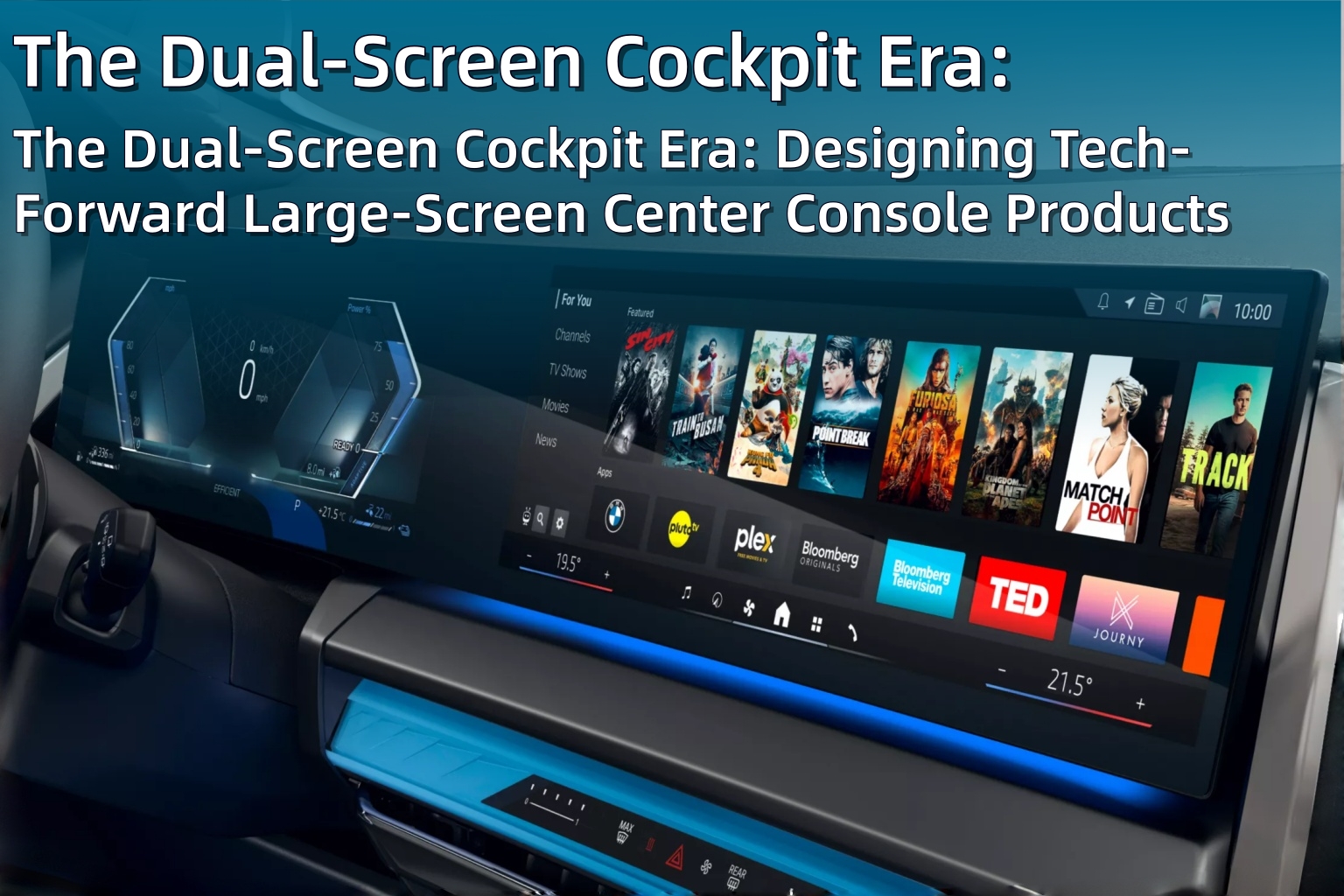
The first is the cluster-plus-center integrated dual-screen. This is a single physical display assembly — often curved, sometimes flat, but always continuous or near-continuous — where the left portion functions as the digital instrument cluster and the right portion functions as the center infotainment screen. From the driver's seat, it reads as one wide display. From an engineering standpoint, it's a carefully partitioned system that has to do two very different jobs at once.
The second is the center-plus-passenger integrated dual-screen. Here, the layout shifts rightward. The left portion is the center infotainment screen (shared with the driver for media, navigation, vehicle settings), and the right portion is a dedicated passenger display — typically used for streaming video, browsing, video calls, games, or productivity apps while the vehicle is in motion. This configuration is increasingly common in premium SUVs and in markets where the front passenger is treated as a second primary user, not an afterthought.
These two products look superficially similar in marketing renders. They are not similar in their engineering requirements. The cluster-plus-center configuration is fundamentally a safety-relevant product, because one half of it is the instrument cluster. The center-plus-passenger configuration is fundamentally an entertainment product, because neither half is safety-critical and the design priorities are entirely different.
This distinction drives everything that follows — the SoC, the operating system, the display technology, the validation path, the certification burden, and ultimately the unit cost and the target market.
Category One: Cluster + Center Integrated Dual-Screen
The Safety-First Design Logic
The cluster-plus-center dual-screen is, at its core, a safety-relevant system that happens to also serve an infotainment function. The instrument cluster portion of the display is responsible for rendering the vehicle speedometer, the tachometer, the fuel or battery level, the warning indicators, the turn-signal status, and increasingly, ADAS-related content like surround-view camera feeds and lane-departure warnings.
If that display freezes, stutters, or crashes while the driver is doing 120 kilometers per hour on a highway and trying to merge, the consequences are not "the user is annoyed." The consequences are potentially catastrophic. This is why every credible instrument cluster program in the industry treats the cluster as a safety-critical subsystem, not as a fancy LCD gauge.
That framing changes the design logic at every layer. It changes how you select the SoC, how you architect the software, how you partition the display, how you validate the system, and — most fundamentally — how you choose the operating system.
Why the Cluster Side Runs Linux, Not Android
Here's the design decision that most aftermarket suppliers get wrong, and that most serious OEMs get right by default: the instrument cluster side of a cluster-plus-center dual-screen should run on a Linux-based real-time or near-real-time platform, not on Android.
The reasoning comes down to one word: stability. Android is a remarkable operating system for consumer infotainment. It has a vast application ecosystem, mature media frameworks, excellent Bluetooth and connectivity stacks, and a developer community measured in the millions. It is also — by design — a general-purpose operating system optimized for user experience flexibility rather than for hard real-time guarantees. Its process scheduling, memory management, and garbage collection behaviors are not deterministic enough to guarantee that a safety-relevant rendering task will complete within a bounded time window under all conditions.
In a center infotainment context, that's fine. If your music app hiccups for 200 milliseconds while the system does garbage collection, no one gets hurt. In an instrument cluster context, it's not fine. If the speedometer rendering stalls while the system is handling a background task, the driver loses situational awareness at exactly the moment they need it most.
Linux — specifically, an automotive-grade Linux distribution built on a real-time or low-latency kernel configuration — gives you the determinism and the fault isolation that a safety-relevant display requires. The kernel can be configured for bounded scheduling latency. Critical rendering paths can be isolated from non-critical background processes. The system can be hardened so that a failure in one process doesn't cascade into the cluster rendering path. And, critically, the whole stack can be brought into compliance with ISO 26262 functional safety requirements — typically ASIL-B for a cluster display — in a way that an Android stack simply cannot match without so much wrapping that you've effectively built a Linux system with an Android compatibility layer on top.
This is why, when we design a cluster-plus-center dual-screen product, the architecture is almost always a split system. The cluster side runs on a Linux-based platform with a dedicated, safety-certified rendering path for vehicle-critical information. The center side — if it's part of the same physical display assembly but a separate logical partition — can run Android for the infotainment functions, with a defined boundary between the two domains.
What This Means for Product Design
The practical implications of this architecture are significant, and they show up in ways that matter to buyers.
First, the SoC selection is constrained. You can't just pick the flashiest consumer-grade application processor and drop it into a cluster. The cluster-side SoC needs to have a documented safety case, a long-term supply commitment (typically 10 to 15 years for automotive programs), and the ability to support a real-time or low-latency Linux configuration. The center-side SoC, by contrast, can be a higher-performance part optimized for media and application workloads.
Second, the software development is two parallel efforts. The cluster-side team is building against a Linux BSP with a focus on rendering performance, fault tolerance, and CAN bus integration — pulling real-time vehicle data off the vehicle network and getting it onto the screen within a bounded latency window. The center-side team is building against an Android BSP with a focus on media playback, navigation, connectivity, and user experience. These are different engineering disciplines, and a supplier that only knows how to build one of them will struggle to ship a coherent cluster-plus-center product.
Third, the validation path is more demanding. The cluster side needs environmental testing, EMC testing, and — for OEM programs — functional safety analysis and possibly third-party safety assessment. The center side needs the usual infotainment validation. Treating the product as a single validation exercise leads to gaps; treating it as two coordinated validation streams leads to a product that actually works.
Category Two: Center + Passenger Integrated Dual-Screen
The Entertainment-First Design Logic
The center-plus-passenger dual-screen flips the design priority entirely. Neither side of this display is safety-critical in the way an instrument cluster is. The center screen handles media, navigation, and vehicle settings — same as any head unit. The passenger screen handles whatever the passenger wants to do: stream a movie, take a video call, browse the web, play a game, follow a recipe, kill time on a long drive.
This changes the calculus on every design decision. Instead of "what's the safest, most stable architecture?" the question becomes "what gives the best experience for high-bitrate media, low-latency networking, and responsive application performance?" The answer to that question is very different.
Why the High-End Qualcomm + UIS Approach Wins Here
For the center-plus-passenger configuration, the right design choice — in our experience and in the experience of most Tier 1s building this category — is a high-end Qualcomm automotive SoC paired with a premium UIS (User Interface System) software stack. Here's why.
The Qualcomm automotive Snapdragon family, particularly the higher-tier parts, is built around a design philosophy that prioritizes exactly what a passenger entertainment display needs: sustained high-resolution video decode, multi-stream media handling, GPU performance for rich UI rendering, and integrated connectivity that handles 4G/5G modems, Wi-Fi 6, and Bluetooth without bottlenecking the application path. These are the same silicon foundations that show up in flagship consumer tablets and in the premium infotainment programs of major automakers, and they're tuned for the kind of workloads that a dual-entertainment-screen cockpit generates.
The video decode story matters more than most buyers realize. When the passenger is streaming a 4K movie, the center screen is simultaneously running navigation with live traffic, and the system is also handling a Bluetooth audio stream and a Wi-Fi hotspot for the rear seats — that's a multi-stream workload that will expose any weak SoC immediately. A high-end Qualcomm part handles this kind of concurrent decode and rendering without dropping frames or stuttering, because that's literally what it was designed to do. A cheaper, lower-tier SoC will appear to work in testing and then fall over the first time a real user loads it up.
The UIS software layer is the other half of the equation. A premium UIS stack — the kind that serious suppliers invest in customizing — gives you a launcher, a media framework integration, a windowing system, and a set of UI components that are optimized for the dual-screen use case. It handles the partitioning of content between the center and passenger displays, manages the audio routing (driver gets navigation audio, passenger gets movie audio, both through the right speakers), and provides the app ecosystem hooks that let third-party streaming and productivity apps integrate cleanly.
The combination — Qualcomm silicon on the bottom, a tuned UIS stack on top — is what makes a center-plus-passenger dual-screen feel like a premium product rather than two tablets glued together. It's what lets the passenger watch a 4K stream while the driver's navigation stays responsive. It's what lets a video call run smoothly while the center screen updates traffic in real time. It's what makes the whole thing just work, without the lag and the frame drops that signal a budget implementation.
What This Means for Product Design
Just as the cluster-plus-center architecture constrains the design in specific ways, the center-plus-passenger architecture constrains it in different ways.
The SoC selection is driven by performance, not safety certification. You want the highest-tier Qualcomm part that fits your thermal and cost envelope — not because more megahertz is always better, but because the multi-stream workload of a dual entertainment display will expose under-specced silicon immediately.
The software development is a single, coherent effort on the Android side, but it's a more demanding effort than a single-screen head unit. You're managing two display outputs, two audio zones, two potentially independent application contexts, and the orchestration layer that keeps them from stepping on each other. A supplier that has only ever built single-screen Android head units will need to climb a learning curve to get this right.
The validation path is lighter on the safety side — no ASIL certification required for a passenger entertainment display — but heavier on the performance and user-experience side. You're validating video decode performance under load, networking throughput under concurrent access, thermal behavior under sustained operation, and UI responsiveness across both displays simultaneously. These are different tests than a cluster program runs, and they need a different test bench.
Why You Can't Mix the Two Logics
Here's the mistake we see most often, and it's worth calling out directly: trying to run both sides of a cluster-plus-center dual-screen on Android, on the theory that a single OS simplifies the architecture and a single SoC reduces the BOM cost.
It sounds reasonable on a whiteboard. It fails in practice.
The reason it fails is that the two sides of the display have fundamentally incompatible requirements. The cluster side needs determinism, fault isolation, and safety compliance. Android doesn't give you those things without so much wrapping that you've effectively built a Linux system underneath. The center side needs media performance, connectivity, and a rich application environment. A safety-hardened Linux system gives you those things only awkwardly, and at a development cost that dwarfs the supposed savings from avoiding a second OS.
The right architecture — the one that serious suppliers actually ship — is a split system. Linux on the cluster side, with a dedicated real-time rendering path for vehicle-critical information. Android on the center side, on a performance-optimized SoC, with a full media and connectivity stack. A defined boundary between the two domains — typically a hypervisor or a hardware partition — that lets them share a physical display assembly without sharing a failure domain. If the center side crashes, the cluster side keeps rendering. If the cluster side has a fault, it fails safe in a defined state, and the center side continues to function for non-critical tasks.
For the center-plus-passenger configuration, the logic is simpler — both sides are entertainment, both sides can run on a single high-end Android stack, and the design effort goes into the orchestration layer rather than the domain partitioning. This is why the center-plus-passenger product, despite looking more complex in renders, is often the simpler engineering problem. The cluster-plus-center product looks simpler but is actually the harder one, because of the safety architecture it requires.
What This Means for B2B Buyers
If you're sourcing dual-screen products, the categorization above should change how you evaluate suppliers.
If you're buying a cluster-plus-center product for an OEM program, you need a supplier who can demonstrate Linux-based cluster development, ISO 26262 awareness, CAN bus integration depth, and a real partitioning architecture between the cluster and infotainment domains. Ask to see their safety case. Ask how they handle a center-side crash without affecting the cluster. Ask what SoC they use on the cluster side and what its safety certification status is. A supplier who can't answer these questions clearly is not a supplier who should be building your cluster.
If you're buying a center-plus-passenger product, you need a supplier who can demonstrate high-end Qualcomm integration, multi-display Android orchestration, video decode performance under load, and a mature UIS customization capability. Ask to see a dual-screen demo running concurrent video on both displays. Ask what their audio routing architecture looks like when both displays are playing media. Ask what their sustained-load thermal profile is. A supplier who can only demo a single-screen head unit and talks vaguely about "extending" it to dual-screen is a supplier who will deliver a product that works in the lab and stutters in the field.
The price differential between a properly architected dual-screen product and a shortcut version is real, and it's not small. But the cost differential between shipping a product that works and shipping one that gets returned is much larger. This is a category where the cheapest quote is almost never the right quote.
Where the Category Is Going
A few trends worth tracking if you're planning a multi-year product roadmap around dual-screen cockpits.
First, the cluster-plus-center and center-plus-passenger configurations are starting to converge into a single three-display layout — cluster, center, and passenger — on a single physical display assembly. This raises the architectural stakes significantly, because now you have a safety-critical domain (cluster) and two entertainment domains (center and passenger) on one physical surface. The partitioning architecture has to be more sophisticated, and the supplier selection has to be more rigorous.
Second, the line between the center display and the passenger display is starting to blur functionally. Features like "passenger-assist navigation" — where the passenger can set or modify the route from their side and push it to the center display — require a more tightly coupled architecture between the two entertainment domains than a simple independent-stream model. Suppliers who are investing in this kind of cross-display orchestration now will have a meaningful advantage in two to three years.
Third, the SoC roadmap is moving toward more integrated, multi-domain parts that can run a safety-certified partition and a high-performance entertainment partition on a single chip, with hardware-enforced isolation between them. This is the direction the industry is heading, and it will eventually simplify the dual-OS architecture that's currently the right answer. But we're not there yet — for the next product cycle at least, the split-system approach remains the right engineering choice.
The Bottom Line
Dual-screen cockpit products are not one category. They're two, with different design logics, different operating system requirements, different SoC selections, and different supplier capability profiles. The cluster-plus-center configuration is a safety-first product that demands Linux on the cluster side and a disciplined partitioning architecture. The center-plus-passenger configuration is an entertainment-first product that demands high-end Qualcomm silicon and a tuned UIS stack for multi-stream media performance.
Getting this distinction right — at the spec stage, at the supplier evaluation stage, at the architecture stage — is what separates a dual-screen cockpit that ships and succeeds from one that ships and disappoints. At Dingpei Industry (Shenzhen) Co., Ltd., we design and manufacture both configurations, and we've built our engineering teams to handle the distinct requirements of each. If you're sourcing dual-screen products for a wholesale line, a brand program, or an OEM vehicle platform, the conversation about which architecture fits your requirement is one we're set up to have — and it's a conversation worth having before you commit to a supplier who treats all dual screens as the same problem.
Looking for a dual-screen cockpit supplier? Dingpei Industry (Shenzhen) Co., Ltd. designs and manufactures cluster-plus-center and center-plus-passenger integrated dual-screen products for global wholesalers, brand owners, and vehicle manufacturers. Contact us to discuss your display architecture, SoC requirements, and program timeline.


 English
 Russian