Explore how electric vehicle (EV) digital instrument clusters and Android-based infotainment systems are evolving together in modern cockpit design. This article explains CAN bus integration, HMI architecture, EV dashboard functionality, and real-world system design concepts inspired by next-generation EV platforms, including charging screens, ADAS-ready displays, and multi-screen cockpit synchronization.
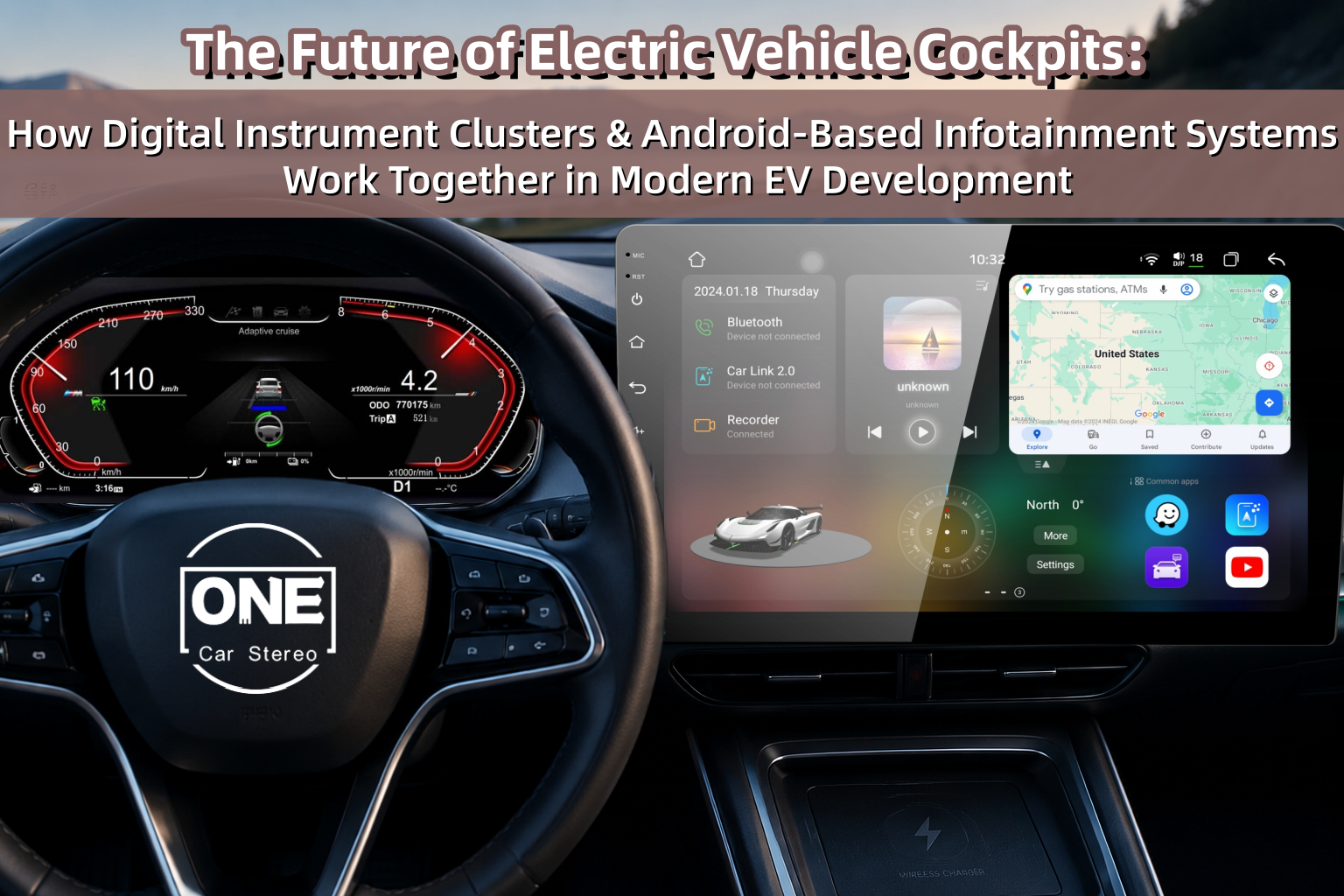
1. Introduction: The EV Revolution Is Redefining the Cockpit
The electric vehicle industry is no longer defined only by batteries, motors, or range. One of the most important transformations is happening inside the cabin—specifically in the cockpit system, where drivers interact with the vehicle every second.
Traditional cars used analog gauges, separate infotainment units, and limited connectivity. Modern electric vehicles are shifting toward fully digital ecosystems, where the instrument cluster, central infotainment system, and connectivity stack work as one integrated computing platform.
At the center of this transformation are two major systems:
· The digital instrument cluster (DIC)
· The Android-based infotainment and navigation system
These are no longer independent components. Instead, they are tightly synchronized through vehicle communication networks such as CAN bus, Ethernet, and middleware HMI frameworks.
In modern EV development, especially in next-generation cockpit platforms similar to the LIUX cockpit system architecture, the focus is on:
· Real-time vehicle data visualization
· Seamless user experience between screens
· Intelligent energy and battery monitoring
· Adaptive UI (day/night mode)
· Voice, touch, and steering wheel integration
· Deep integration of navigation, media, and vehicle control
This article explores how these systems are designed, how they interact, and why co-development between instrument clusters and Android infotainment platforms is becoming essential for automotive manufacturers and suppliers.
2. The Evolution of the Digital Instrument Cluster in Electric Vehicles
The digital instrument cluster has evolved from a simple speedometer replacement into a real-time data visualization hub.
In electric vehicles, the cluster is responsible for displaying critical information such as:
· Battery State of Charge (SOC)
· Driving range (autonomy)
· Power consumption and regeneration
· Gear state (R, N, D, S)
· Vehicle warnings and alerts
· Speed and driving mode
· Charging status
Modern EV cluster design focuses heavily on clarity, safety, and minimal distraction.
2.1 EV-Specific Instrument Cluster Requirements
Unlike combustion engine vehicles, EVs require unique data structures:
Battery-Centric Display Logic
A core difference is that nearly all driving decisions depend on battery status. A modern cluster must show:
· SOC percentage (0–100%)
· Graphical battery bars (often segmented into 17 or similar levels)
· Color-coded warning thresholds (white → red zones)
· Remaining range estimation (km)
For example, in a modern cockpit design concept:
· 100%–21% SOC → normal white UI state
· 20%–0% SOC → critical red state
This color transition is not aesthetic—it is a safety requirement.
Energy Flow Visualization
EV clusters often include:
· Instant power consumption (kW)
· Regenerative braking (negative kW values)
· Average consumption (kWh/100km)
· Instant consumption feedback
This allows drivers to understand energy behavior in real time, improving efficiency.
Thermal Management Display
Battery temperature is also critical:
· Display in Celsius
· “BATTERY” label shown explicitly
· Integrated with BMS (Battery Management System)
Thermal data directly impacts performance and safety decisions.
3. CAN Bus as the Nervous System of the EV Cockpit
The Controller Area Network (CAN bus) remains the backbone of vehicle communication in most EV architectures.
In systems similar to modern cockpit designs, the CAN network typically operates at:
· 500 kbps baud rate
· 120Ω termination resistance
3.1 What CAN Transmits in a Modern EV Cockpit
The instrument cluster receives real-time signals such as:
· Speed
· SOC
· Gear position
· Turn signals
· Lighting states (DRL, low beam, high beam)
· Door status
· Seatbelt status
· Brake and motor fault signals
· Battery faults (HV/LV)
· Maintenance alerts
· Power loss indicators
It also receives user input signals:
· Steering wheel buttons
· Volume control
· Call control
· Menu navigation
· Mode switching
3.2 Why CAN is Still Critical
Even though modern EVs are moving toward Ethernet-based architectures, CAN remains essential because:
· It is highly reliable
· Low latency
· Fault tolerant
· Cost-effective
· Widely standardized
For safety-critical cockpit systems, CAN remains the primary real-time data source.
4. Android-Based Infotainment Systems in EVs
While the instrument cluster focuses on driving data, the infotainment system handles user experience, media, navigation, and connectivity.
Modern EVs increasingly adopt Android Automotive OS or Android-based infotainment platforms due to:
· Flexible UI development
· App ecosystem integration
· Navigation capabilities
· Voice assistant support
· OTA update support
4.1 Core Functions of Android Infotainment Systems
Typical functions include:
· Music playback (Bluetooth / streaming)
· Phone call management
· Navigation (GPS-based routing)
· App ecosystem (maps, media, vehicle apps)
· Voice control
· Vehicle settings interface
4.2 Bluetooth Integration
Modern systems often support:
· Device pairing with dynamic naming (e.g., vehicle serial-based IDs)
· Music metadata display:
o Song name
o Artist name
o Album art (optional)
Importantly, infotainment systems must ensure low-latency audio switching for calls and media.
4.3 Navigation System Requirements
Android-based navigation is a critical component of EV usability.
Key features include:
· Real-time GPS tracking
· EV range-aware routing
· Charging station mapping (future integration)
· Traffic updates
· Multi-route selection
Navigation is no longer just map display—it is directly linked to energy management.
5. The Core Concept: Instrument Cluster and Infotainment Co-Development
One of the most important trends in EV cockpit design is co-development of the digital cluster and infotainment system.
Instead of building two separate systems, manufacturers now design them as a unified architecture.
5.1 Why Integration Matters
If the systems are isolated, problems occur:
· Duplicate data processing
· UI inconsistency
· Latency in updates
· Poor user experience
· Higher hardware cost
Integrated development solves these issues by:
· Sharing vehicle data layer
· Synchronizing UI states
· Using unified HMI logic
· Reducing redundancy
5.2 Shared Data Architecture
A modern EV cockpit typically uses a layered architecture:
Layer 1: Vehicle Data Layer
· CAN bus
· BMS
· BCM
· Sensors
Layer 2: Middleware Layer
· Signal processing
· Data filtering
· State management
Layer 3: Application Layer
· Instrument cluster UI
· Infotainment UI (Android)
· Navigation system
Layer 4: User Interaction Layer
· Touch screen
· Steering wheel buttons
· Voice control
6. LIUX-Style Cockpit Design Principles (Real-World Example)
Modern cockpit systems—similar to those used in LIUX-inspired architectures—follow strict design principles.
6.1 Multi-Zone Display Layout
A typical layout includes:
· Left: Battery + energy + range
· Center: Driving data + alerts
· Right: Media + communication
· Top: Status indicators
· Bottom: Fault alerts
This structure ensures cognitive separation of information.
6.2 Charging Mode UI
When the vehicle is charging, the cockpit switches into a dedicated mode:
· Charging time remaining (hours/minutes)
· Green SOC visualization
· Charging power (kW)
· Battery capacity (kWh)
· Charging status indicator
The system detects charging state via CAN message (e.g., ChargingMode signal).
6.3 Reverse Camera Integration
When gear shifts to R:
· Full-screen rear camera is activated
· Key indicators remain visible:
o Speed
o Turn signals
o Status icons
This ensures safety while maintaining awareness.
6.4 Night Mode Adaptation
Night mode is not a separate UI—it is a theme layer:
· Same layout
· Different color scheme
· Reduced brightness
· Improved contrast
Triggered by BCM signal.
6.5 Radar and Audio Warning System
Parking radar feedback uses:
· 0 = no sound
· 1 = slow beep (0.5s interval)
· 2 = faster beep (0.25s interval)
· 3 = continuous beep
This system is directly linked to speaker output.
7. Steering Wheel Control Integration
Modern EV cockpits rely heavily on steering wheel controls.
Typical functions:
· Volume control (+/-)
· Call pickup/hang up
· Mode switching
· Menu navigation
· Media control (play/pause)
These inputs are transmitted via CAN signals and interpreted by both cluster and infotainment systems.
8. Android Navigation + Instrument Cluster Synchronization
One of the most advanced features in modern EV architecture is synchronization between:
· Navigation system (Android)
· Instrument cluster (real-time driving data)
8.1 Range-Aware Navigation
Navigation systems now calculate:
· Remaining battery range
· Estimated arrival SOC
· Charging stop requirements
This requires real-time data exchange between Android system and vehicle ECU.
8.2 Dual-Screen Data Sharing
Example interactions:
· Navigation shows route → cluster shows energy impact
· Cluster shows SOC drop → navigation recalculates route
· Charging station selected → cluster updates charging mode
9. Bluetooth, Media, and Communication Layer
The infotainment system handles:
· Music streaming
· Phone calls
· Contact management
But integration with cluster ensures:
· Incoming calls override UI priority
· Music metadata is mirrored
· Steering wheel controls affect both systems
Call pop-ups have highest priority and override other displays.
10. System Safety and Priority Logic
A critical part of cockpit design is priority management.
Priority hierarchy:
1. Safety alerts (battery faults, brake failure)
2. Phone calls
3. Driving warnings
4. Navigation
5. Media playback
6. Secondary messages
This ensures driver attention is always focused correctly.
11. Future Trends in EV Cockpit Development
The industry is moving toward:
11.1 Centralized Computing Platforms
Instead of multiple ECUs:
· One central cockpit computer
· Virtualized clusters and infotainment
11.2 Android + Automotive OS Fusion
· Android handles UI
· Real-time OS handles safety data
11.3 AI-Assisted Cockpits (Limited Use)
· Driver behavior adaptation
· Predictive energy management
· Smart UI switching
11.4 Cloud Connected Cockpits
· OTA updates
· Remote diagnostics
· Fleet data analysis
12. Business Opportunity in EV Cockpit Systems
For automotive suppliers and trade companies, cockpit systems represent a high-growth sector:
· Instrument cluster modules
· Android infotainment head units
· CAN interface controllers
· Display panels (LCD/TFT/OLED)
· HMI software stacks
Demand is especially strong in:
· Electric passenger vehicles
· Commercial EV fleets
· Emerging EV startups
· Retrofit EV conversion markets
13. Conclusion: Unified Cockpit Systems Define the Next Era of EVs
The electric vehicle revolution is not only about propulsion—it is about digital experience.
The integration of:
· Digital instrument clusters
· Android-based infotainment systems
· CAN-based real-time vehicle communication
· Intelligent UI/UX design
is creating a new standard in automotive engineering.
The future cockpit is no longer a set of separate screens. It is a single intelligent ecosystem, where every piece of data—from battery temperature to navigation routes—is connected, synchronized, and optimized for both safety and usability.
As EV adoption continues to grow globally, companies that master cockpit co-development will play a critical role in defining the next generation of mobility.


 English
 Russian